 THE RESERVE SYSTEM
Mental Reserve
Stress regulation governs every layer above it.
The Reserve System™
The public framework behind Before the Alarm: understand what the body can carry, what is loading it, and how much reserve remains before the alarm.
How the models relate
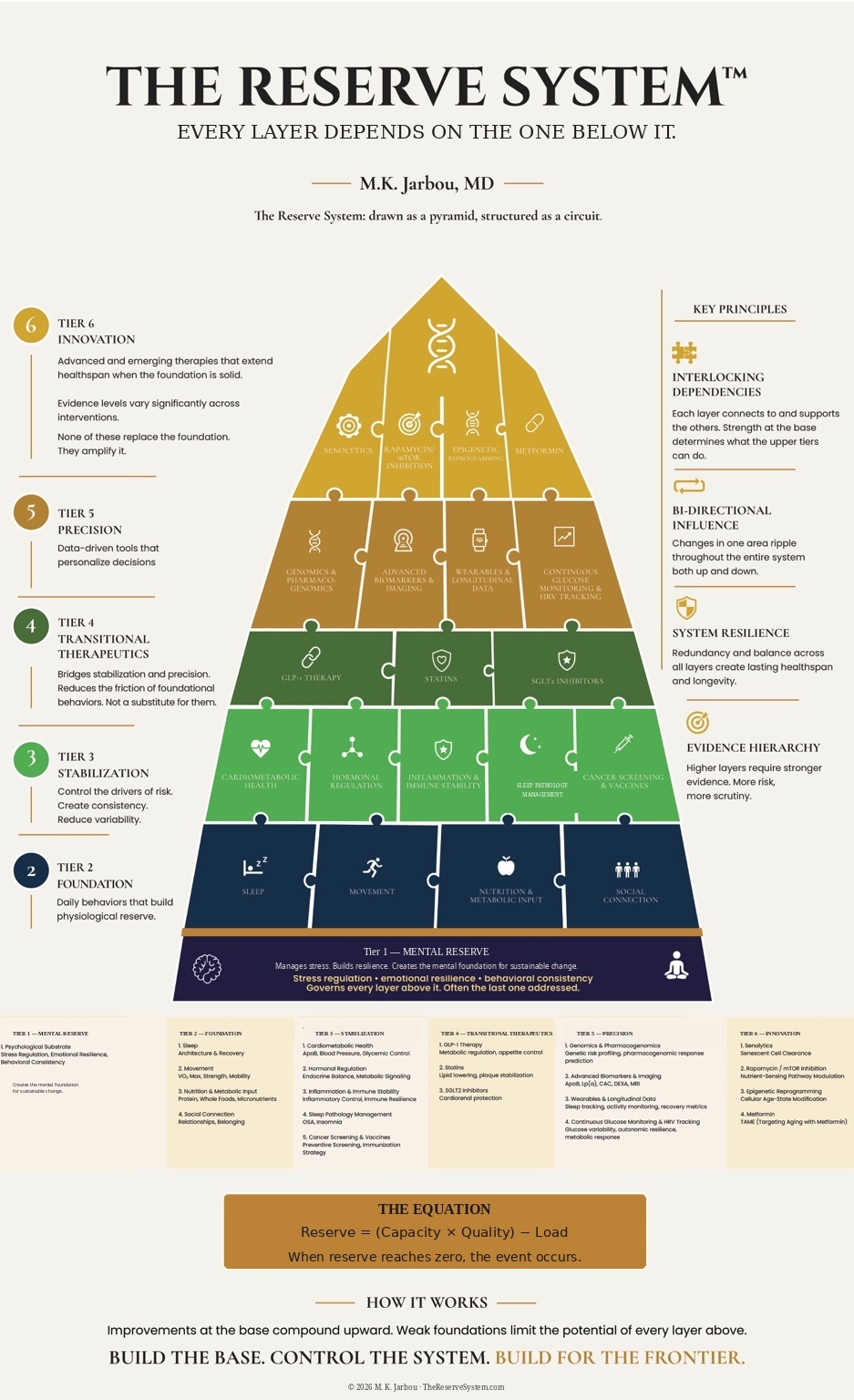
In Chapter 2, The Reserve System™ is introduced as a pyramid to show dependency: Mental Reserve, Foundation, Stabilization, Transitional Therapeutics, Precision, and Innovation do not carry equal weight. Later in the book, the circuit model shows how the body behaves under load.
The pyramid helps a reader see sequence: the base supports the apex. The circuit explains motion: sleep, stress, glucose, inflammation, muscle, medications, and environment are constantly feeding back into one another.
Why sequence matters
What it corrects
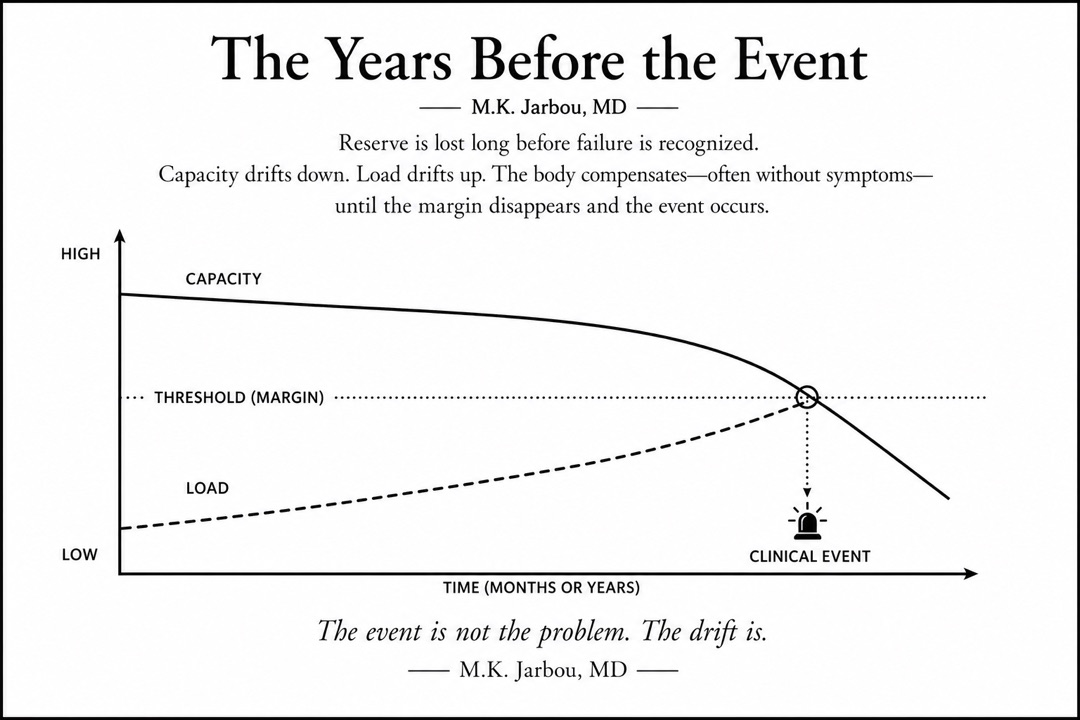
The pyramid is drawn as a hierarchy because a diagram has to impose order. Biology behaves more like a circuit. Sleep reaches into glucose. Stress reaches into inflammation. Muscle reaches into independence. Connection reaches into immune resilience.
The apex amplifies what the base can support. When the foundation is unstable, advanced interventions amplify instability.
Six tiers
The tier names are intentionally precise. The work is not to simplify biology until it becomes harmless. The work is to put each intervention where it belongs.
Stress regulation governs every layer above it.
Sleep, fitness, nutrition, and connection build the body’s margin.
Blood pressure, glucose, sleep apnea, hormones, inflammation, and screening stop quiet erosion.
Bridges stabilization and precision. Reduces the friction of foundational behaviors — not a substitute for them.
Data-driven testing that personalizes decisions and optimizes outcomes.
Advanced and emerging therapies that extend potential when the foundation is solid. They amplify the base — they never replace it.
The handoffs
The physician who treats blood pressure but does not ask about sleep. The longevity clinic that runs a precision panel on a patient sleeping five hours a night. The patient investing in the innovation tier while the foundation drifts.
Those are not isolated mistakes. They are sequence failures.